Cannabis seed packaging must protect living genetics, preserve lot identity, and carry required information. Licensed cultivators, breeders, seed banks, and dispensaries often answer to several authorities. These may include cannabis regulators, agriculture departments, general seed laws, packaging rules, and local retail agencies.
A polished package can still create problems if it breaks traceability. An oversized child-resistant container may also add cost and waste without protecting seed viability. Start with the seed’s legal classification, intended buyer, sales channel, and destination. Document every claim about cultivar identity, feminization, germination, disease resistance, or cannabinoid potential.
Cannabis and agricultural seed laws change often. Before production, ask legal counsel and the relevant regulators to review the package. This article provides general business information, not legal advice.
Why Cannabis Seed Packaging Requires Careful Planning
Seed packages protect the product and support regulated recordkeeping. A package may provide the last physical link between breeding records and a licensed cultivator’s inventory. If identifiers conflict, staff may struggle to investigate complaints or isolate an affected lot.
Federal law does not always treat seeds like mature cannabis plants. Marijuana remains federally controlled. However, federal law defines hemp according to its delta-9 THC concentration on a dry-weight basis.
The Drug Enforcement Administration has stated that seeds meeting the federal hemp threshold can fall within the hemp definition. The agency expressed that view through correspondence, which does not override state law. State cannabis, hemp, seed, import, and intended-use restrictions may still apply.
State regulators may limit who can produce, transfer, or sell seeds. Federal law still prohibits interstate transportation of marijuana, including transfers between adult-use states. Do not assume that low seed THC levels resolve every interstate issue. The destination state matters as much as the state of origin.
Start With the Product’s Legal Classification
Classify the seed before approving its package. It may qualify as marijuana seed within a licensed system, hemp seed for planting, or agricultural seed. A regulator may also recognize another category with different requirements.
The classification affects licensing, testing, transfer documents, sales channels, and label language. Calling seeds “souvenirs” or “novelties” does not necessarily avoid regulation. Regulators may consider the seller’s knowledge, instructions, claims, and intended use.
The Federal Seed Act and USDA rules may cover seeds sold for planting in interstate commerce. Required information can include kind, variety, lot identity, purity, origin, germination, test date, and weed-seed content. The exact fields depend on the seed category and transaction.
State agriculture departments often impose separate requirements. These may include seed labels, dealer licenses, registrations, testing, and stop-sale authority. Confirm the rules in every destination state.
Within marijuana markets, cannabis agencies may require seeds to remain in the licensed supply chain. They may also require entries in an inventory or seed-to-sale tracking system. Some jurisdictions treat seeds, clones, immature plants, and finished products differently.
Do not copy a competitor’s label. Instead, ask regulatory counsel to prepare a written requirements matrix for each market.
Core Cannabis Seed Packaging Requirements
No single national seed label works across every cannabis market. However, several fields commonly support traceability, product identity, and truthful sales. Use the following list as a starting point, then compare it with the controlling rules.
- Responsible business information: List the required legal name and contact details for the producer, packer, distributor, or licensee.
- License information: Include cannabis, hemp, nursery, or seed-dealer numbers when regulators require them.
- Seed identity: Use a legally supportable kind, variety, cultivar, or product designation.
- Lot or batch number: Assign a unique identifier that connects production, testing, packing, and transfer records.
- Seed count or net quantity: Follow the applicable seed and weights-and-measures rules.
- Testing information: Provide required germination, purity, weed-seed, pathogen, or related results and dates.
- Tracking identifier: Add the required inventory tag, barcode, or state tracking number.
- Required warnings: Apply mandated symbols, age statements, planting restrictions, or other warnings only when required.
- Storage instructions: Give concise directions that protect viability without promising an unsupported shelf life.
Do not automatically add a THC symbol, universal warning, or “21+” mark to every packet. Adult-use cannabis sales generally require buyers to be at least 21. However, exact seed warnings and age controls depend on the state and sales channel.
Unnecessary symbols can mislead buyers, especially when hemp seed moves under agricultural rules. Confirm each required statement instead of relying on a standard cannabis label template.
Labels need sufficient contrast, type size, and open space for reliable reading. Print quality must remain clear after filling, sealing, shipping, and handling. Test every variable field at its smallest expected size.
Keep a durable lot identifier with the seeds. If staff discard a removable sleeve, the inner container should remain traceable.
Package Formats by Business Size and Use Case
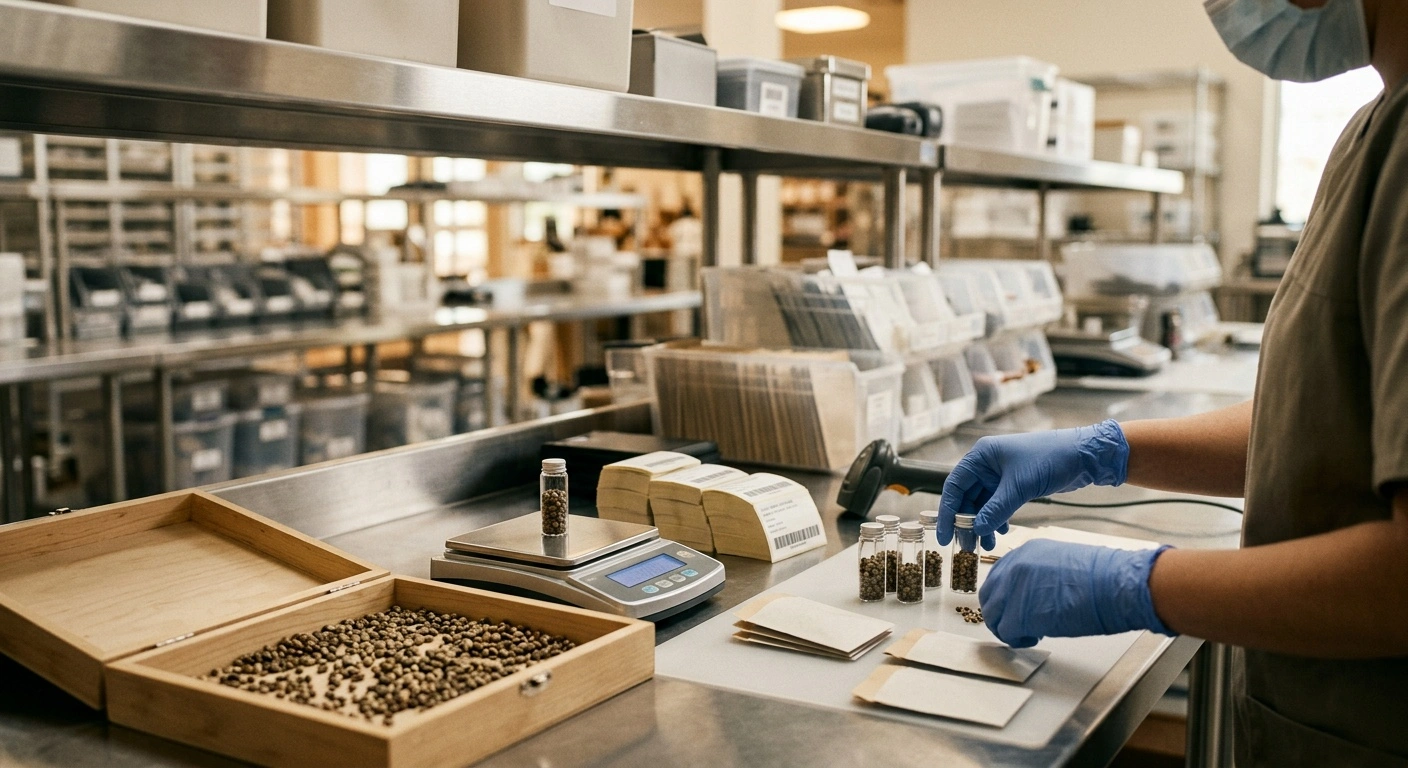
Choose a format based on seed count, handling risk, sales environment, and inventory procedures. Retail packets often prioritize display space and individual identification. Breeder and cultivation transfers usually need stronger resealability and larger operational labels.
The package should prevent crushing and keep seeds out of seams. Staff must also be able to count and reconcile the contents without damaging them.
| Use case | Practical format | Advantages | Limitations | Typical cost tier |
|---|---|---|---|---|
| Small retail seed count | Paperboard card with an internal vial or sealed insert | Good print area, easy merchandising, and physical protection | More assembly; recycling may require component separation | Mid-range |
| Direct-to-consumer packet | High-barrier pouch with a rigid internal holder | Low weight, ample label space, and optional tamper evidence | The pouch may not prevent crushing; multilayer films can hinder recycling | Low to mid-range |
| Premium genetics release | Small rigid container inside a printed carton | Strong protection and room for batch information | Higher material and shipping costs; greater overpackaging risk | High |
| Breeder-to-cultivator transfer | Resealable container with a tamper-evident outer seal | Supports repeated counts and internal inventory control | Staff need documented procedures for resealing after opening | Mid-range |
| Bulk licensed production | Seed-appropriate rigid container with a replaceable lot label | Stackable, compression-resistant, and efficient for larger counts | Less suitable for display; requires disciplined reconciliation | Low per seed, with a higher initial unit cost |
A cheap container becomes expensive if employees must recover escaped seeds or replace unreadable labels. A premium box can also cause trouble if it wastes space or hides required information.
Request filled samples before placing a production order. Test them during receiving, storage, picking, shipping, and point-of-sale work.
Protect Seed Viability Without Unsupported Claims
Cannabis seeds are living agricultural material. Heat, moisture, light, crushing, and frequent environmental changes can reduce storage performance. The package should provide stable, dry, dark conditions and suitable physical protection.
A rigid vial or insert can protect small quantities from pressure. Its closure should remain secure, and its seams should not trap seeds. Check the complete container rather than judging the cap and vial separately.
Barrier films can reduce moisture exchange. Base material specifications on measured storage and shipping conditions, not phrases such as “airtight forever.” Select desiccants carefully because uncontrolled drying may also damage seeds.
Any insert or desiccant must suit the intended use around seed. Confirm its composition, placement, capacity, and handling instructions before production.
Support shelf-life and germination statements with data from representative lots under defined conditions. Do not apply one batch’s result to every cultivar or production run. The word “guaranteed” can create legal and customer-service obligations.
Run seal-integrity, vibration, drop, and barcode tests that reflect actual distribution conditions. Include expected warehouse temperatures and humidity levels. Record the test method, sample size, acceptance criteria, and result.
Keep those records. They provide useful evidence during complaints, recalls, and vendor disputes.
Child Resistance, Tamper Evidence, and Retail Security
Do not automatically treat seed packages like edible cannabis. However, do not assume an exemption. State rules differ on child resistance, opacity, exit packaging, tamper evidence, and warning language.
Ask the cannabis regulator to confirm the requirement for the license type and transaction. Keep the response with the package approval file when possible.
If a state requires child resistance, request current test documentation from the supplier. The documentation should cover the complete container-and-closure system under the cited standard. A certified cap may fail when paired with a different vial or liner.
Changes to materials, dimensions, closures, or assembly methods may affect test status. Route every proposed substitution through compliance and quality review.
Tamper evidence serves a separate purpose. It shows employees and customers that someone may have opened the package. Shrink bands, tear strips, breakaway closures, and destructible seals can provide visible evidence.
A decorative sticker offers little protection if someone can remove and replace it cleanly. Test the seal after shipping and routine handling.
Retailers also need loss-prevention controls because seed packets are small. Options include locked displays, staff-controlled sample cards, serialized stock, and end-of-shift reconciliation. These controls may work better than a bulky consumer package.
Creative Packaging Ideas That Support Compliance
Creative cannabis seed packaging should help buyers identify the product without crowding required information. A restrained visual system can distinguish breeding lines, seed types, or lots. Keep the compliance panel in a consistent location.
Do not rely on color as the only identifier. Colors can look different across print runs and disappear in black-and-white records.
Build the Design Around Lot Traceability
Place the lot number, product identity, and machine-readable code in fixed positions. A light variable-data panel can improve scanning and reduce printing errors. It also keeps staff from placing stickers over instructions or warnings.
QR codes can link to batch-specific documents, breeder notes, test results, or contact details. However, the printed label must still show all information that the law requires on the package.
Maintain linked pages for the applicable record-retention period. Test redirects and archived pages regularly. An old lot must not lead to results for a newer batch.
Use Structure to Explain the Product
A paperboard card with a protected vial can create an organized seed-library format. It also keeps customers from handling loose seeds. Make sure the card does not hide the lot code or required statements.
A narrow viewing window can help buyers confirm that the container holds product. However, clear areas admit light and may conflict with opacity rules. Review both product protection and state requirements before adding a window.
Seed color and surface pattern do not reliably prove genetic quality. Avoid designs that encourage buyers to treat appearance as a substitute for records or testing.
A reusable metal or rigid container can resist compression. It also adds material, shipping weight, and cost. Place the durable identifier on the inner container so traceability remains after buyers discard the outer carton.
Make Sustainability Claims Specific
Start sustainable design by removing unnecessary layers. Consider right-sized cartons, reusable breeder containers, recycled-content paperboard, or simpler material combinations. Do not sacrifice barrier performance or regulatory compliance.
Local collection and processing systems determine whether buyers can recycle a package. Multi-component designs may require separation that customers cannot complete easily.
Avoid broad claims such as “eco-friendly,” “zero waste,” or “biodegradable” without reliable evidence. Consumer-protection rules may require clear qualifications. States may also regulate recyclability labels, recycled content, and producer responsibility.
Ask vendors for material specifications, test reports, and chain-of-custody documents. A sustainability logo alone does not substantiate a claim.
Review Product and Performance Claims
Seed labels often include hard-to-verify claims. Examples include “stable genetics,” “disease resistant,” “high potency,” and “guaranteed female.” Define each claim and keep supporting records before printing it.
Photographs of parent plants or finished flower do not prove how every seed will perform. Cultivation conditions can materially affect yield, cannabinoid content, growth, and disease response.
Terms such as feminized, regular, autoflowering, hybrid, and cultivar names should reflect documented practices. Published sex ratios and germination rates need lot-appropriate evidence. Follow any required testing and labeling methods.
Do not guarantee cannabinoid concentration or yield when environmental conditions influence the result. Use clear qualifications where evidence supports a narrower statement.
Review intellectual property before approving cultivar names and artwork. Names can raise trademark, licensing, contract, or plant-variety issues. Informal industry use does not guarantee commercial availability.
Avoid medical claims. Seeds do not qualify as FDA-approved treatments. Claims about curing anxiety, pain, cancer, or other conditions can trigger serious regulatory and consumer-protection concerns.
Describe documented lineage and agronomic traits instead. Keep the language factual and tied to available records.
Connect Labels With Seed-to-Sale Records
Licensed marijuana businesses should connect each package identifier to the required inventory record. Complete this step before units reach the sales floor or leave production.
Regulators may track seeds individually, by count, by package, or through another approved unit. Obtain written instructions from the state agency. Do not rely only on software defaults.
Label software does not need to replace the state system. It must reproduce data accurately. Reduce manual entry for lot numbers, license numbers, quantities, and package identifiers.
Use role-based permissions and audit logs where possible. These controls show who printed, voided, or reprinted each label.
Reprints need strict control because duplicate physical labels can suggest diversion. Create a procedure for approvals, destruction of the old label, and record retention. Cover split lots, repacking, returns, and count discrepancies in the same procedure.
For complaints or recalls, staff should quickly identify the source lot and packing date. They should also retrieve test documents, transfer history, and recipient records. Missing chain-of-custody records can defeat an otherwise sound package.
Run a mock trace before launch. Correct gaps before the first commercial shipment.
Questions to Ask a Packaging Vendor
Vendors vary in their knowledge of cannabis and agricultural seed rules. Suppliers can provide technical documents, but licensed businesses must assess the finished package. Avoid asking only whether a product is “cannabis compliant.”
Instead, send a structured request for information:
- Which materials contact the seeds, and can the vendor provide complete specifications?
- What moisture, oxygen, and light-barrier data support the finished structure?
- Has the exact container-and-closure combination passed required child-resistance testing?
- What evidence supports tamper, recycled-content, recycling, composting, or environmental claims?
- What tolerances apply to printing, label placement, seal strength, and dimensions?
- Can the vendor print and verify variable lot numbers, barcodes, or tracking identifiers?
- How does the vendor control printing errors, overruns, and obsolete regulated materials?
- What minimum orders, tooling costs, lead times, and reorder risks apply?
- Can the vendor supply printed and unprinted samples for compatibility and distribution testing?
- How will the vendor disclose material or manufacturing changes before the next order?
Compare more than the empty package price. Include tooling, artwork revisions, labels, assembly labor, testing, storage, damage, and obsolete stock. These costs can turn a low unit quote into an expensive program.
Short-run digital printing may suit breeders with many small lots. Larger producers may save money through standard components and variable labels.
Use a Documented Approval Process
Start with a requirements sheet for each market. Identify the regulator, license type, seed classification, sales channel, label statements, tracking fields, and package features. Ask legal and compliance staff to approve the sheet before final design.
This order of work protects space for required content. It also reduces expensive artwork revisions.
Next, build a physical prototype with the planned vial, insert, label, seal, and seed count. Route it through receiving, inventory entry, storage, picking, retail display, and customer handling.
Confirm that employees can read the lot code and scan the barcode. They should also be able to count units and recognize tampering without damaging the package.
Review the artwork line by line against the approved requirements sheet. Check cultivar spelling, responsible-party details, quantity, licenses, tests, warnings, and printed codes. Assign someone other than the designer to verify variable data.
Finally, establish change control. New films, caps, adhesives, printers, sizes, or manufacturers can alter performance and compliance. Require compliance, quality, and operations teams to approve substitutions before use.
Build a Packaging System That Can Adapt
Cannabis seed rules can change through legislation, regulations, agency guidance, and court decisions. A standard protective container with market-specific labels often simplifies updates. It can also reduce obsolete stock after warning, license, or testing changes.
Maintain current links to cannabis regulators, agriculture departments, USDA resources, and controlling laws. Review requirements before entering a new state or adding a sales channel. Repeat the review after classification changes or before interstate distribution.
Approval in one cannabis market does not transfer automatically to another. Record who approved each package, which rules they reviewed, and when the review occurred.
The strongest cannabis seed packaging protects viable seeds and keeps required information with the product. It also supports inventory reconciliation and provides a defensible account of the contents. Good design makes those functions clearer instead of competing with them.