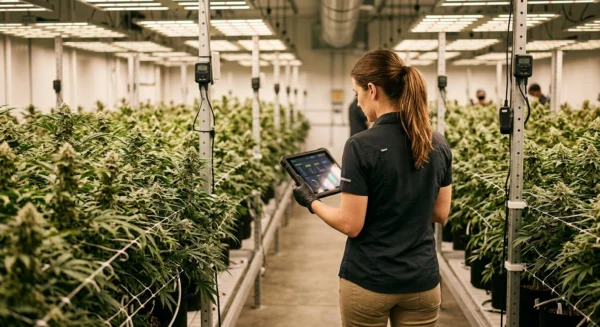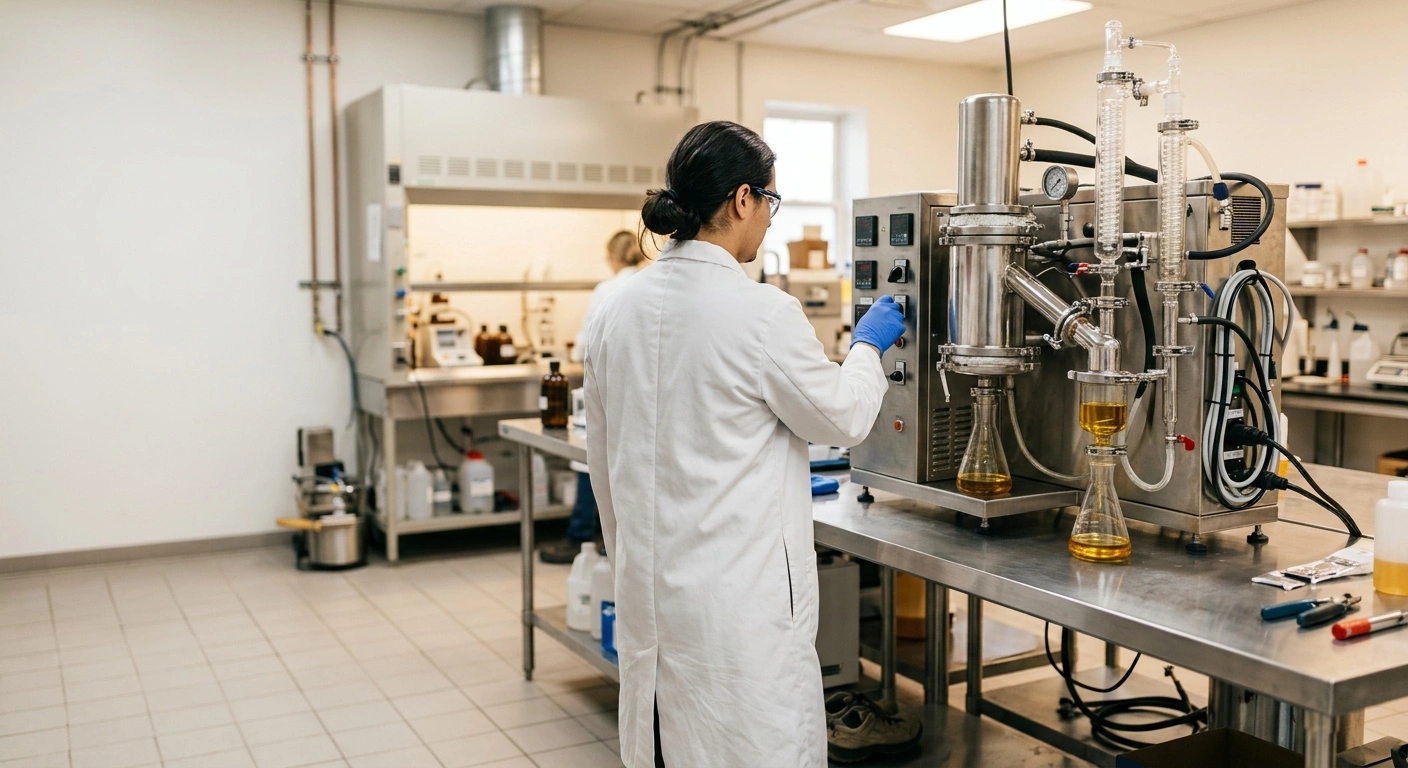
Cannabis distillation equipment helps licensed processors refine prepared cannabis oil under vacuum. The process separates compounds based on differences in volatility. Safe operation requires an engineered facility, trained staff, documented procedures, and all required manufacturing licenses.
Distillation differs from extraction. Extraction removes cannabinoids and other compounds from plant material. Distillation further refines an extracted and prepared feedstock.
The process can create a concentrated, relatively neutral cannabinoid fraction. However, it cannot automatically make contaminated oil safe or compliant. Equipment selection must account for upstream processing, throughput, worker safety, quality controls, tracking rules, and finished-product specifications.
How Cannabis Distillation Equipment Works
Distillation uses evaporation and condensation. Controlled heat and reduced pressure cause selected compounds in prepared oil to evaporate. A cooled surface then condenses those vapors into a separate liquid fraction.
Less volatile material remains in the evaporator or exits through another collection path. The design must keep each fraction separate and limit unwanted carryover.
Vacuum plays a central role because cannabinoids have high boiling points. Excessive heat or long exposure can degrade them. Lower pressure reduces the temperature required for evaporation.
System design also controls how long the oil remains on a heated surface. Operators must balance pressure, heat transfer, surface area, feed consistency, and residence time. Qualified process personnel should develop and validate each method.
Short-path batch systems
A traditional short-path apparatus uses a heated boiling flask, internal condenser, receiving vessels, vacuum pump, temperature controls, and cold traps. Vapor travels only a short distance before reaching the condenser. Operators process a defined batch before cleaning and resetting the apparatus.
Batch systems suit research, process development, small production runs, and facilities that handle multiple formulations. They also demand close operator attention. Conditions change as lighter components leave and the remaining material becomes more viscous.
Glass assemblies can break, and cleaning often takes significant labor. Scale-up also requires engineering review. A successful small-flask method may fail at larger volumes because heat transfer, vapor flow, and residence time change.
Wiped-film and thin-film systems
Wiped-film equipment spreads feedstock into a thin layer across a heated evaporator. Rotating wipers distribute the oil, increase its exposed surface area, and limit thermal exposure. Vapors move toward a condenser while heavier residue travels to a separate outlet.
Some systems place the condenser inside the evaporator body. Others use a short external vapor path. Both designs aim to reduce the distance between evaporation and condensation.
Manufacturers often choose this architecture for larger or continuous production. It can provide controlled feed movement and shorter heat exposure than a boiling flask. However, the design adds seals, pumps, controls, moving parts, and product-contact surfaces.
Feed viscosity and cleanliness directly affect performance. Solids, waxes, or inconsistent material can restrict flow and reduce heat transfer. Buyers should test achievable output with representative feedstock instead of relying on an advertised maximum rate.
What molecular distillation means
Equipment companies often use the term “molecular distillation” loosely. In technical use, it describes very-low-pressure distillation with little distance between the evaporating surface and condenser. That arrangement reduces collisions between vapor molecules before condensation.
Some wiped-film systems can operate within that general regime. Still, the label says little about construction quality or production performance. Buyers should ask vendors to define the term and provide measurable acceptance criteria.
Useful evidence includes leak-rate specifications, loaded vacuum performance, condenser capacity, and materials documentation. Test results should come from comparable feedstock. A process engineer or qualified technical lead should confirm that the design fits the intended separation.
Major Components of a Distillation System
A distillation line includes more than an evaporator. Its performance depends on the vacuum train, feed delivery, thermal equipment, collection vessels, controls, and facility utilities. One undersized component can limit the entire line.
For example, an undersized chiller may reduce condensation capacity. A contaminated vacuum line can also cause unstable operation. Careful system integration helps prevent downtime and unsafe maintenance conditions.
Product-contact materials must tolerate the feedstock and approved cleaning agents. Stainless steel, borosilicate glass, seals, hoses, and gaskets require different care. Buyers should request material certificates and identify every lubricant or elastomer that could contact the process stream.
| Component | Primary function | What buyers should evaluate |
|---|---|---|
| Evaporator | Transfers heat and provides an evaporation surface | Surface design, materials, cleaning access, feed compatibility, and expected residence time |
| Condenser | Cools vapor and returns it to liquid form | Surface area, coolant demand, cleaning access, and capacity under the expected vapor load |
| Vacuum pump and controls | Reduce pressure and maintain stable operating conditions | Pump type, chemical compatibility, service needs, exhaust handling, instrumentation, and loaded performance |
| Cold trap | Captures volatile compounds before they reach the pump | Capacity, cooling demand, drainage, cleaning, and safe handling of collected material |
| Feed system | Moves prepared oil into the evaporator at a controlled rate | Viscosity range, pump design, solids tolerance, cleanability, and calibration |
| Heating and cooling units | Supply thermal control to the evaporator and condenser | Capacity, operating range, fluid compatibility, alarms, electrical demand, and ventilation needs |
| Collection vessels | Receive condensed fractions and remaining residue | Closed handling, sampling, labeling, cleaning, and grounding where required |
| Instrumentation and controls | Monitor pressure, temperature, feed movement, and equipment status | Sensor accuracy, calibration access, data logging, alarms, permissions, and audit trails |
What Must Happen Before Distillation
Distillation cannot correct poorly prepared feedstock. Extracted oil may contain waxes, pigments, water, acids, suspended solids, or residual solvents. The exact mixture depends on the upstream extraction and refinement methods.
Licensed facilities often use separate preparation steps to improve feed consistency. Each step needs suitable equipment, ventilation, fire protection, waste controls, and written procedures. Staff must also document the material’s identity and status.
Some production sequences convert cannabinoids from acidic forms before or during processing. That conversion releases gases and changes the oil’s physical behavior. Engineers must account for those changes when sizing equipment and developing controls.
The correct sequence depends on the extraction method, product specification, and system design. This article does not provide operating instructions for extraction, solvent processing, or distillation. Qualified personnel must supervise those activities inside licensed facilities.
Why Distillation Does Not Guarantee Contaminant Removal
A clear distillate does not prove that a product is safe. Contaminants may follow the desired fraction, remain in residue, or become more concentrated. Equipment, utilities, cleaning chemicals, and poor handling can also introduce contamination.
Some pesticides behave unpredictably during thermal separation. Heavy metals may originate in plant material or product-contact components. Residual solvents and volatile degradation products also require analytical review.
Processors must assess every production batch under the rules of the market where they plan to sell it. Required panels may cover potency, pesticides, residual solvents, microbes, mycotoxins, heavy metals, and other analytes. Requirements vary by jurisdiction and product type.
Processors should use laboratories that the applicable regulator licenses or recognizes. Quality staff must review the complete certificate of analysis, not only the cannabinoid result. Distillation must never serve as a way to disguise failed material.
Licensing, Facility Design, and Code Compliance
Cannabis distillation generally requires a state manufacturing or processing license and local authorization. A cultivation or retail license may not permit concentrate manufacturing. License categories and operating rules vary by jurisdiction.
Before ordering equipment, operators should contact the cannabis regulator, planning department, fire authority, and building department. Some agencies request equipment lists, floor plans, process descriptions, or engineering documents during licensing.
Local authorities may review electrical service, ventilation, fire suppression, egress, equipment anchoring, gas detection, and hazardous-material storage. Volatile solvents can change room classifications and equipment requirements. Electrical components may also need certification from a nationally recognized testing laboratory.
A listed component does not guarantee approval for an assembled system. The local authority having jurisdiction makes the final code determination. Early review can prevent costly facility changes after delivery.
Vacuum, pressure, and thermal hazards
Vacuum equipment can create an implosion hazard. Scratched, stressed, unsupported, or incorrectly rated glass increases that risk. Staff should inspect glassware and supports before each approved use.
Heating systems create burn, fire, and product-degradation hazards. Chillers and cold traps expose workers to cold surfaces and thermal fluids. Pumps may release hot exhaust, oil mist, noise, or vapors that require controlled ventilation.
A cooling, vacuum, feed, or control failure can change process conditions quickly. Facilities should complete a documented hazard review before commissioning. Qualified personnel should evaluate guards, shields, alarms, emergency stops, thermal protection, and pressure relief where applicable.
Staff need task-specific protective equipment and clear emergency procedures. Those procedures should cover leaks, broken glass, abnormal pressure, power loss, and equipment faults. Before maintenance, workers must isolate, cool, and depressurize the system under an approved lockout/tagout procedure.
Solvent and fire safety
Prepared feedstock may retain volatile compounds from upstream processing. This remains possible even when the distillation stage adds no solvent. Cold traps and vacuum exhaust can collect or release flammable vapors.
Fire and ventilation reviews should address the full material stream, not just the evaporator. Facilities must identify, store, and discard waste or recovered fractions under applicable rules. Environmental, fire, and cannabis regulations may all apply.
Home solvent extraction and improvised distillation can cause fires, explosions, toxic exposure, and severe injuries. Many jurisdictions prohibit these activities. Licensed laboratories should use approved closed systems, qualified professionals, and procedures accepted by local authorities.
Production targets never justify bypassing ventilation, grounding, electrical, or fire-code requirements.
Quality Systems and Documentation
Consistent distillate depends on controlled procedures as well as reliable hardware. A laboratory should define feed specifications, batch identification, equipment status, cleaning steps, sampling, storage, and release criteria. Staff should also document all in-process checks and collection decisions.
Records must connect each finished lot with its source material, operators, equipment, process data, and laboratory results. Regulated markets may also require reconciliation with a seed-to-sale tracking system.
Standard operating procedures should match the installed equipment and approved process. Laboratories should not copy a vendor manual without review. Each facility must adapt its procedures to local rules, hazards, staffing, and product requirements.
Quality teams should schedule instrument calibration and document critical maintenance. Formal change control should cover software updates, replacement seals, revised feed specifications, and process changes. Staff must investigate deviations and out-of-specification results instead of making undocumented corrections.
Cleaning and cross-contamination control
Residue can collect on evaporator walls, wipers, condensers, hoses, seals, and collection paths. Buildup reduces heat transfer and can obstruct material flow. It may also carry residue from one batch into the next.
Cleaning procedures should name approved agents, disassembly steps, inspection points, and acceptance criteria. Campaign scheduling and line-clearance controls become more important when facilities handle multiple cannabinoid profiles or remediation work.
Facilities should match cleaning verification to product risk and regulatory requirements. Visual inspection helps, but it may miss chemical residue or cross-contamination. Analytical verification may be necessary for higher-risk products or changeovers.
Staff should trace product-contact parts and replace damaged seals or scratched surfaces under a preventive maintenance plan. Equipment design should support safe cleaning. Workers should not have to reach around hot surfaces or lift unstable glass assemblies.
Choosing Equipment by Lab Size and Use Case
The right equipment category depends on the laboratory’s production model. Research teams often value flexibility, visibility, and small batch sizes. High-volume manufacturers may prioritize continuous feed, automation, uptime, and faster cleaning.
Contract processors often need broad feedstock tolerance because clients supply different materials. Vertically integrated operators may control feed consistency more closely. However, their distillation schedule often depends on cultivation and extraction output.
Buyers should treat throughput claims as conditional. Feed composition, viscosity, preparation, purity targets, operator experience, cleaning frequency, and acceptable loss all affect output. A maximum rate from ideal test conditions may not reflect routine production.
Request demonstrations with comparable material and define acceptance tests before purchase. Include warmup, cleaning, maintenance, sampling, setup, and changeover time in capacity calculations. Product movement alone does not represent total operating time.
| Use case | Likely equipment approach | Main advantages | Main limitations |
|---|---|---|---|
| Research and process development | Small batch short-path or pilot-scale thin-film system | Flexible, visible, and suitable for method development | Limited scale, high labor demand, and uncertain transfer to full production |
| Small licensed manufacturer | Production batch system or compact wiped-film unit | Supports moderate batch variety with a smaller facility footprint | Operator attention and cleaning time can restrict output |
| High-volume processor | Integrated wiped-film line with controlled feed and data capture | Consistent flow, short thermal exposure, and higher potential utilization | Higher capital cost, complex maintenance, and greater utility demand |
| Multi-product or contract laboratory | Flexible system with accessible product paths and controlled changeovers | Handles varied campaigns and client specifications | Requires stronger validation and cross-contamination controls |
Cost Tiers and Total Cost of Ownership
Distillation systems range from simple pilot units to integrated production lines. Pricing changes with scale, materials, controls, certifications, installation scope, and support. Buyers should tie every quote to a written specification.
The base price may exclude pumps, chillers, heaters, controls, freight, commissioning, training, or spare parts. Facility modifications can add substantial costs. A low initial quote may become expensive if utilities or components require replacement.
Entry-tier systems usually involve more manual handling, lower throughput, and limited automation. Mid-tier systems may add integrated feed control, data logging, and easier cleaning. Higher-tier installations can include automated controls, redundant utilities, and remote diagnostics.
Total cost analysis should include labor, yield loss, cleaning, consumables, pump service, calibration, energy use, and downtime. Buyers should also review replacement-part availability and expected service response times.
Staffing and Training Requirements
Operators need more than the ability to follow prompts on a control screen. They should understand vacuum systems, heat transfer, material behavior, contamination control, and instrumentation. They must also recognize warning signs of unstable operation.
Training should cover chemical hygiene, protective equipment, emergency response, waste handling, lockout/tagout, and inventory controls. Some jurisdictions require worker permits or occupational badges.
A qualified supervisor should review deviations and identify conditions outside the validated range. Maintenance personnel need system-specific training for pumps, seals, controls, and thermal equipment. Quality staff need authority to stop or reject a batch.
Vendor instruction can support the training program. It should not replace the laboratory’s own competency assessment and documentation.
Questions to Ask Cannabis Distillation Equipment Vendors
Vendor discussions should begin with the laboratory’s feedstock, target products, regulations, and facility limits. Buyers should not choose a system from a headline throughput claim. Written responses allow direct comparisons and create a record for purchase agreements.
Include engineering, operations, safety, and quality representatives in the review. Each group will identify different risks and requirements.
- Feed compatibility: What feed characteristics can the system handle, and which conditions invalidate performance claims?
- Throughput basis: What material supported the stated capacity, and did the test exclude cleaning or changeover time?
- Vacuum performance: Which pump configuration does the system require, and how does the vendor test it under load?
- Product-contact materials: Can the vendor document all metals, glass, seals, hoses, lubricants, and gaskets?
- Safety certification: Which components or assemblies carry third-party listings, and will local authorities accept them?
- Facility requirements: What electrical, ventilation, thermal, drainage, floor-space, and exhaust provisions does the system need?
- Controls and records: Can the system log data, preserve audit trails, manage permissions, and export usable records?
- Seed-to-sale workflow: How will staff reconcile weights, losses, samples, waste, and finished lots?
- Cleaning: Which parts require removal, how long does changeover take, and which areas resist inspection?
- Service: Where does the vendor stock parts, and which repairs require a vendor technician?
- Acceptance testing: Will the vendor document installation, operational, and performance checks with representative material?
- Training: Which operator, maintenance, safety, and troubleshooting courses come with the purchase?
Building a Defensible Procurement Plan
The right cannabis distillation equipment must support safe operation, reliable maintenance, effective cleaning, and complete documentation. A licensed laboratory should prepare a written user requirement specification before collecting bids. The review should cover the entire production process, not only the evaporator.
That process includes feed preparation, testing, inventory control, waste handling, and finished-product release. Technical teams should also assess facility utilities, staffing, cleaning capacity, and expected downtime.
Before signing a contract, operators should confirm state licensing and obtain required local approvals. Purchase documents should define performance, accessories, utilities, training, acceptance testing, warranties, spare parts, and service response.
Finally, the schedule should allow time for commissioning, staff qualification, method development, and regulatory inspection. Careful procurement takes time. It also reduces the risk of installing a system that cannot meet safety, quality, or compliance requirements.