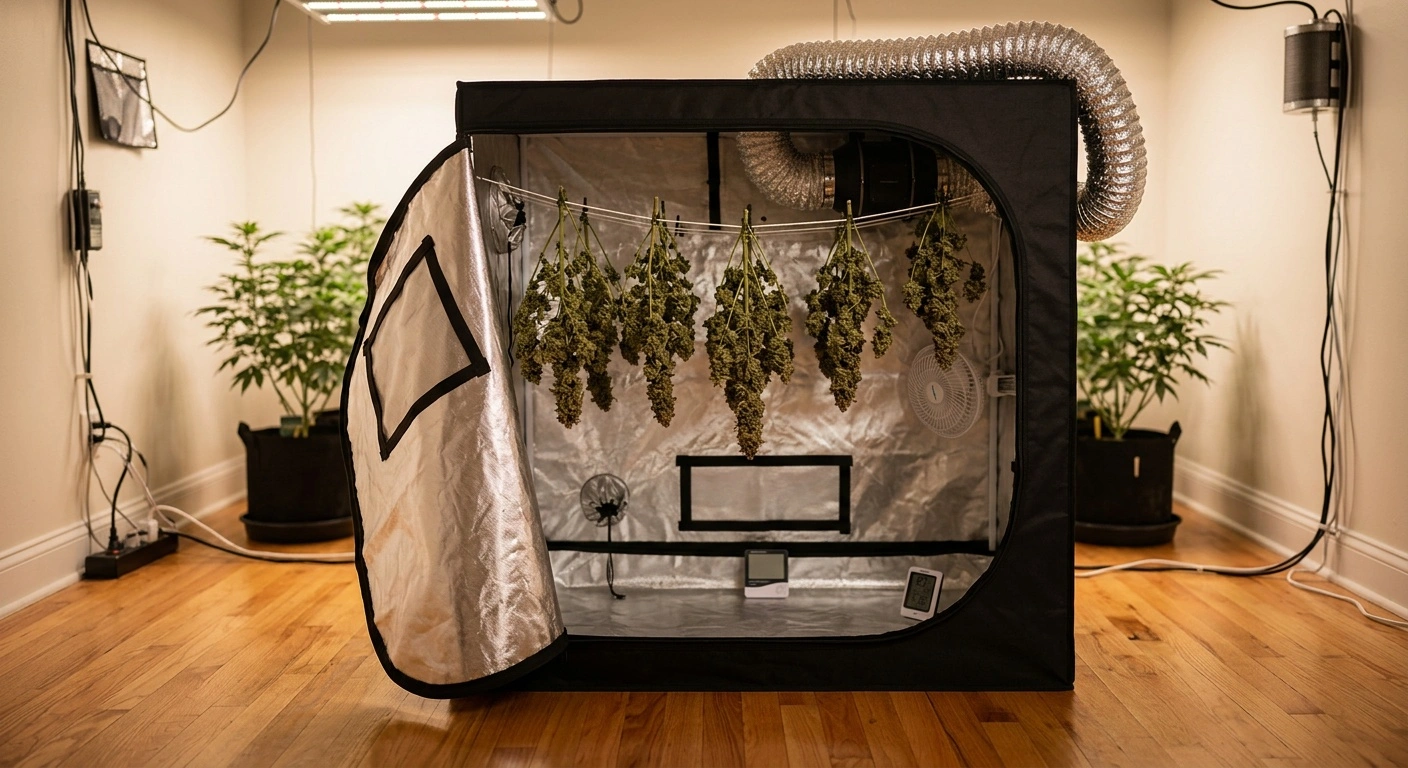
A cannabis drying tent gives legal home growers a dark, contained space for managing airflow, temperature, and humidity after harvest. It works well when you lack a dedicated drying room. However, the tent cannot correct a hot, damp, or poorly ventilated room by itself.
Home cultivation remains illegal in many states. Local rules may limit plant counts, require locked areas, or ban plants from public view. Check current state and local laws before growing or drying cannabis. Federal law also prohibits marijuana outside narrow federally authorized contexts.
Drying requires more than waiting for curing to begin. Moisture must leave the harvested plant slowly and evenly. Drying too quickly harms aroma and texture, while drying too slowly increases mold risk.
What a Cannabis Drying Tent Does
A cannabis drying tent usually has a lightproof fabric shell, metal frame, ventilation ports, and overhead support bars. These features create a smaller environment that is easier to monitor than a bedroom, garage, basement, or shed.
The enclosure also contains plant debris and helps reduce odor. Connecting the exhaust to a correctly sized carbon filter improves odor control. However, no home setup can guarantee complete odor removal.
The tent does not cool, heat, humidify, or dehumidify the air. Conditions depend largely on the surrounding “lung room,” which supplies the intake air. A fan will keep drawing hot, humid air into the tent if the room itself remains hot and humid.
A closed tent also limits light exposure. Strong light and excess heat can degrade cannabinoids and aromatic compounds after harvest. The enclosure further protects the harvest from pets, dust, pests, and routine household activity.
How Temperature, Humidity, Airflow, and Light Affect Drying
Drying moves moisture from inside the harvested flower into the surrounding air. Fast drying can leave crisp surfaces while moisture remains inside dense flowers. Slow drying creates damp conditions that favor mold and bacterial growth.
Many growers use conditions near 60°F and 60 percent relative humidity as a starting point. This guideline is not a guarantee or rigid requirement. Flower density, branch size, equipment accuracy, airflow, and room conditions all affect the process.
Warmer air usually speeds moisture loss and may reduce volatile aromatic compounds. Persistently high humidity slows moisture removal and increases mold risk. Monitor trends instead of reacting to every short change on a display.
Air should move through the enclosure and around the harvest. Do not point a fan directly at flowers. Strong airflow dries exposed surfaces too quickly and can produce uneven results.
Keep light exposure low throughout drying. Brief inspections will not cause a problem, but leaving the tent open in a bright room defeats its purpose. Check whether controller lights or other devices add noticeable heat.
Benefits of Using a Drying Tent
The main benefit is control within a manageable space. A small enclosure responds more predictably to ventilation changes than an open room. It also keeps branches away from floors and normal household traffic.
Smooth tent surfaces and removable floor liners simplify cleaning. After drying, you can disassemble the tent or return it to cultivation use. Clean all equipment and let the enclosure dry fully before adding live plants.
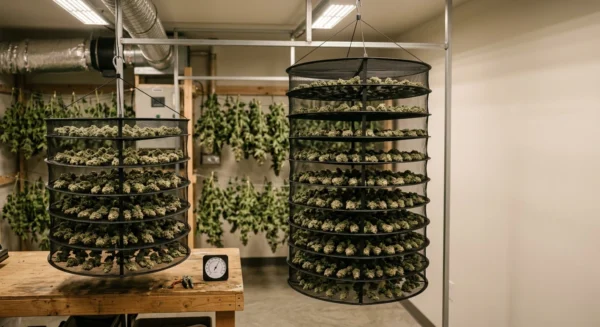
Ventilation ports accommodate an inline fan, ducting, and carbon filter. Support bars also provide attachment points for lines, hangers, sensors, and lightweight mesh racks.
A tent keeps the harvest organized for daily inspection. You can compare readings at different heights and inspect dense flowers for moisture. This matters because mold can develop in one pocket even when a hygrometer shows an acceptable average.
Drawbacks and Limitations
A drying setup adds equipment costs, noise, and electrical demand. Fans and room controls may run for long periods. Small spaces also react quickly when equipment is too powerful.
For example, an oversized exhaust fan can replace air too aggressively. That makes humidity harder to stabilize and may dry the flower unevenly. Use an adjustable fan and make small changes.
Limited space creates another problem. Touching flowers and overlapping leaves form damp, stagnant pockets. A tent that held mature plants may lack enough room to dry the full harvest safely.
Dehumidifiers, portable air conditioners, and fan motors can release heat. Placing them inside a small enclosure may solve one problem while causing another. In most cases, condition the surrounding room and exchange stable air through the tent.
Do not treat the zipped enclosure as sealed storage. Fresh cannabis releases substantial moisture and needs controlled air exchange. Dusty carbon filters, restricted ducting, and inaccurate hygrometers can also undermine the setup.
Drying Tent Compared With Other Spaces
A suitable drying space stays dark, clean, secure, and reasonably stable. A tent offers a practical compromise for many legal home harvests. Larger harvests may require a dedicated room, while small amounts may fit inside a ventilated cabinet.
| Option | Best fit | Advantages | Limitations |
|---|---|---|---|
| Drying tent | Small to midsize legal home harvests | Dark, washable, contained, and easy to ventilate | Can become crowded and depends on room conditions |
| Dedicated drying room | Larger harvests or frequent use | More workspace and room for environmental equipment | Requires a secure room and more conditioned air |
| Ventilated cabinet | Very small harvests | Compact and discreet | Offers limited spacing and fewer ventilation options |
| Open room or closet | Rooms that already maintain suitable conditions | Requires little additional equipment | Provides less odor control, sanitation, and light protection |
Do not choose a size based only on floor dimensions. Whole branches consume vertical and horizontal space. Mesh racks save space, but overloaded racks create flattened contact points that retain moisture.
Leave enough clearance to inspect every level without brushing against the harvest. The surrounding room must also handle exhaust, noise, odor, and electrical loads safely.
Exhausting damp air into the same closed room can raise the room’s humidity. The tent may then draw that moisture back through its intake. Treat the room and enclosure as one connected environmental system.
Equipment You Will Need
Measure conditions before buying devices that change them. Reliable readings show whether you need cooling, moisture control, or better air exchange. Two hygrometers can reveal vertical differences and help identify a faulty sensor.
Use clean equipment that carries appropriate ratings for the space. Avoid damaged cords, overloaded power strips, improvised wiring, and unstable fan mounts. Ask a licensed electrician for help if you have doubts about circuit capacity.
- Clean, lightproof tent: Choose enough space to separate branches or rack layers from walls and one another.
- Hanging lines, bars, or mesh racks: Use hardware that can support wet material without sagging or tipping.
- Digital thermometers and hygrometers: Place sensors at flower height instead of only near the floor or ceiling.
- Adjustable inline exhaust fan: Pair it with a compatible speed controller for measured air exchange.
- Filtered or screened intake: Let replacement air enter without introducing excessive dust, insects, or light.
- Carbon filter: Use correct sizing and airflow to reduce odor. Replace the filter when performance declines.
- Small circulation fan: Direct gentle air around the harvest, never straight at the flowers.
- Clean pruning tools and gloves: Use them to handle branches and isolate damaged material.
- Cleaning supplies: Choose products suitable for tent surfaces and follow the manufacturer’s directions.
- Optional room controls: Use heating, cooling, humidification, or dehumidification only when measurements show a need.
- Safe electrical connections: Use grounded outlets, suitable circuit protection, and drip loops where appropriate.
How to Set Up and Use the Tent
Prepare the enclosure before harvest. Wet branches should not sit in an uncontrolled room while you assemble equipment. Run the empty setup long enough to observe temperature, humidity, noise, light leaks, and equipment heat.
Expect the environment to change after loading fresh material. Newly cut plants release moisture, so empty-tent readings will not represent loaded conditions. Adjust equipment gradually and watch overall trends.
-
Clean and dry the enclosure. Wipe the walls, floor liner, bars, racks, fan housings, and accessible duct surfaces. Let every surface dry fully.
Working cue: You see no dust, condensation, old plant debris, or musty residue. -
Install the exhaust high and intake low. A high exhaust removes warm, moist air that collects near the top. Keep duct runs direct because tight bends restrict airflow.
Working cue: The closed walls pull inward slightly without collapsing. -
Place sensors at flower height. Put one sensor near the upper hanging level and another lower down when possible. Keep them away from direct intake air, exhaust openings, and humidifier mist.
Working cue: Stable readings show whether one area stays warmer or more humid. -
Install lines or racks with clearance. Leave space between branches, rack layers, and fabric walls. Spread smaller pieces in one loose layer.
Working cue: You can inspect each piece without moving piles or rubbing flowers together. -
Inspect material before loading it. Remove dead leaves, pest contamination, and flowers with gray, white, brown, or fuzzy growth. Never dry visibly moldy cannabis for consumption.
Working cue: Only clean material enters the enclosure. -
Load without crowding. Secure whole branches or distribute smaller pieces evenly across racks. Large branches dry more slowly than small, closely trimmed pieces.
Working cue: Air has space to move around every branch or flower. -
Set gentle circulation. Aim the fan toward a wall, open space, or beneath the hanging material. Leaves and branches should remain mostly still.
Working cue: Air circulates without making exposed surfaces crisp. -
Adjust air exchange slowly. Increase exhaust only enough to remove humid air. Condition the surrounding room if its air remains unsuitable.
Working cue: Temperature and humidity stay relatively stable without condensation or repeated large swings. -
Inspect the harvest every day. Check dense flowers, branch junctions, corners, and rack contact points. Use clean hands or gloves.
Working cue: Moisture declines gradually without fuzzy growth, wet pockets, or sour odors. -
Transfer dry flower to curing containers. Do not rely only on surface dryness. Smaller stems often crack when bent, while flowers retain slight internal resilience.
Working cue: Container humidity settles near the commonly used curing range of 58 to 62 percent.
How to Tell When Drying Is Finished
No calendar can determine the exact finish date. Branch size, flower density, trimming style, room conditions, and plant structure all affect drying time. Use several indicators instead of relying on one test.
Test flowers from different heights and locations. Do not sample only a dry branch near the intake. Properly dried flower should feel dry outside without crumbling under light pressure.
The stem test offers useful information, but it is not definitive. Thin stems may snap while thicker stems remain flexible. Dense flower interiors may also hold moisture after their surfaces feel dry.
After transfer, place a small hygrometer inside a clean, airtight curing container. General curing guidance often targets 58 to 62 percent relative humidity. If the reading stays above the intended range, return the flower to the drying space for more time.
Store curing containers in a cool, dark, and secure place. Keep cannabis locked away from children and pets. For accidental ingestion, call Poison Control at 1-800-222-1222. Call 911 if severe symptoms develop.
Troubleshooting a Cannabis Drying Tent
Fuzzy Growth, Soft Spots, or Musty Odor
Crowding, stagnant air, contaminated material, or prolonged high humidity may cause these signs. Isolate and discard affected cannabis. Inspect nearby flowers, clean the enclosure, and correct the environmental problem.
Do not smoke, vaporize, cook with, or process visibly moldy flower. Processing does not reliably make contaminated material safe.
Brittle Flower Surfaces
Direct fan exposure, excessive exhaust, low room humidity, or high temperature may remove moisture too quickly. Redirect the fan and reduce unnecessary air speed. Stabilize the surrounding room without spraying or misting the flower.
Persistent Hay or Cut-Grass Smell
Fast drying can contribute to a hay-like smell. Uneven moisture after an early transfer to curing containers may also cause it. Check actual conditions, remove direct airflow, and continue drying if the flower remains too moist.
Drying adjustments may prevent further damage. However, they cannot always restore aroma that has already disappeared.
Insects Inside the Tent
Pests or eggs may enter with harvested plants. They can also pass through an unprotected intake. Remove contaminated material, clean the enclosure, and inspect all intake screens.
Do not apply household insect sprays or unapproved pesticides to harvested flower. Such products can leave unsafe residues.
Electrical, Mold, and Household Safety
Drying equipment may run continuously. Add the electrical loads before connecting fans, heaters, dehumidifiers, or air conditioners. Use manufacturer-approved controllers and avoid daisy-chained power strips.
High-draw appliances may need dedicated circuits. Keep plugs and power strips off the floor and away from spills, condensation, and humidifier output.
Stop using equipment if wiring becomes hot, breakers trip, or plugs show discoloration. Ask a qualified electrician to inspect the installation before restarting it.
Mold affects both product quality and health. People with asthma, allergies, or weakened immune systems should avoid handling contaminated cannabis. Discard affected flower rather than trying to salvage it.
Keep the tent and finished cannabis secure. State or local rules may require locks and protection from public view. Odor control does not replace those security requirements.
Building a Stable Drying Process
A reliable setup depends on the relationship between the enclosure and its surrounding room. Start with accurate measurements, adequate spacing, gentle circulation, and controlled air exchange. Add environmental equipment only when the readings show a clear need.
Keep notes on room conditions, sensor readings, fan settings, branch size, and drying progress. Records can reveal recurring problems, such as damp lower racks or fast-drying upper branches.
Clean the cannabis drying tent after every use and let it dry completely. Replace damaged ducting, unreliable sensors, worn filters, and unsafe electrical parts. With regular monitoring, the enclosure can protect aroma and reduce mold risk before curing begins.